Is Cancer Curable?



As a gastrointestinal oncologist, people often ask me about the possibility of a cure for cancer. A diagnosis of cancer is overwhelming, and patients and their families often hope for a cure.
Cancer affects millions of people worldwide, including India. It involves uncontrolled growth of abnormal cells which grows and then spreads. Cancer is not a single disease. It is a collection of many diseases with a similar underlying mechanism. There are many types of cancer; each behaves differently and is treated differently.
"Our ability to cure cancer depends on several factors, including the type of cancer, stage of cancer, the overall health of the patient and treatment options which are available to the patient."
Type of cancer
Let's focus on gastrointestinal (GI) cancers. Organs of the gastrointestinal or digestive system include the oesophagus (food pipe), stomach, small intestine, large intestine (colon and rectum), appendix, gallbladder, bile duct, pancreas and liver. Cancer can afflict any of these organs. Gastrointestinal cancer includes cancers of the oesophagus (food pipe), stomach, colon and rectum (large intestine), gallbladder, bile duct, pancreas, and liver.
When viewed under the microscope, we can see that these cancers can be of various types. The types are adenocarcinoma, squamous cell carcinoma, neuroendocrine tumour and gastrointestinal stromal tumour (GIST).
Cancer cells are also graded depending on their resemblance to normal cells. The more abnormal the cell, the higher the grade and the faster it is likely to grow and spread.
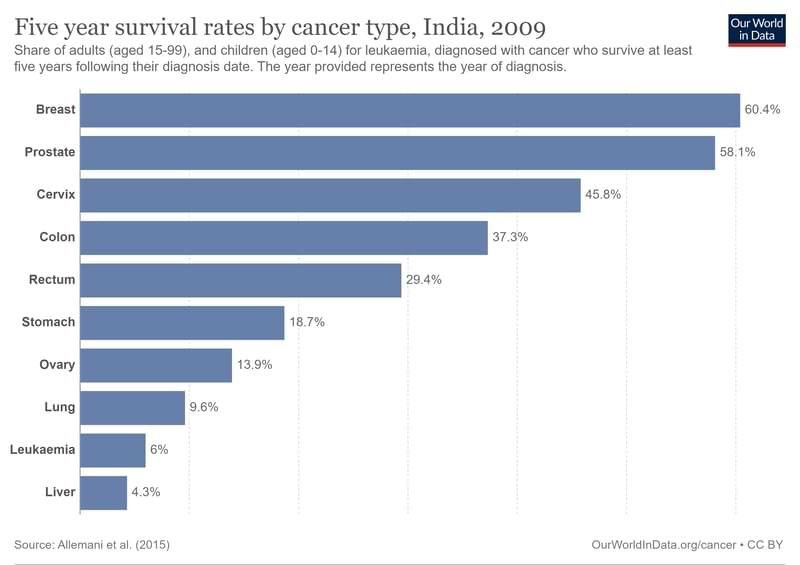
Max Roser and Hannah Ritchie (2015) - "Cancer". Published online at OurWorldInData.org.
The aggressiveness of cancer depends on its organ of origin. Some cancers are more aggressive and fast-growing, while others are slow growing and slower to spread. For example, the five-year survival rate for breast cancer is over 90%, while the five-year survival rate for pancreatic cancer is only about 10%.
Even when the cancer originates from the same organ, there are variations. We call it "biology".
When colon cancer is detected at an early stage, while it is still localised to the colon, the 5-year survival rate exceeds 90%. This implies that approximately 10% of patients may have a more aggressive form of cancer. Science has deciphered some reasons for these variations by looking at the genetic makeup of these cancers.
Stage of cancer
The outcome of treatment of cancer not only depends on the type but also the stage of the disease. We broadly classify cancers into four stages. However, we should understand that it is more like a continuum rather than watertight categories. If we bucket 1 to 100 in four categories, the fourth will contain numbers 75 to 100 and 75 is very different compared to 100.
The stage of a cancer is determined by doing tests and scans like CT, MRI, or PET-CT scans. This work-up will help us assign a stage to the tumour, broadly classifying them into:
- Localised - Tumour is limited to the organ in which it started.
- Regional spread - The tumour has spread to nearby lymph nodes and/or has come out of the wall of the organ in which it started.
- Distant spread - The tumour has spread to organs, which are away from the organ of origin of the tumour, called metastasis.
TNM (Tumour, Node and Metastasis) Classification
Developed by the American Joint Committee on Cancer (AJCC), it is used for classification of the stage. It is based on the following three key elements and spans from I to IV.
- The extent (size) of the tumour (T): How far has the cancer grown? Has cancer reached nearby structures or organs?
- The spread to nearby lymph nodes (N): Has cancer spread to nearby lymph nodes? And how many?
- The spread (metastasis) to distant sites (M): Has cancer spread to distant lymph nodes or distant organs such as the liver or lungs?
Numbers and letters after T, N and M give further details. The higher the number, the more advanced the tumour. Combined Information from T, N and M assigns an overall stage, a process called stage grouping.
Stages I to III are localised diseases and stage IV is advanced cancer (metastatic disease).
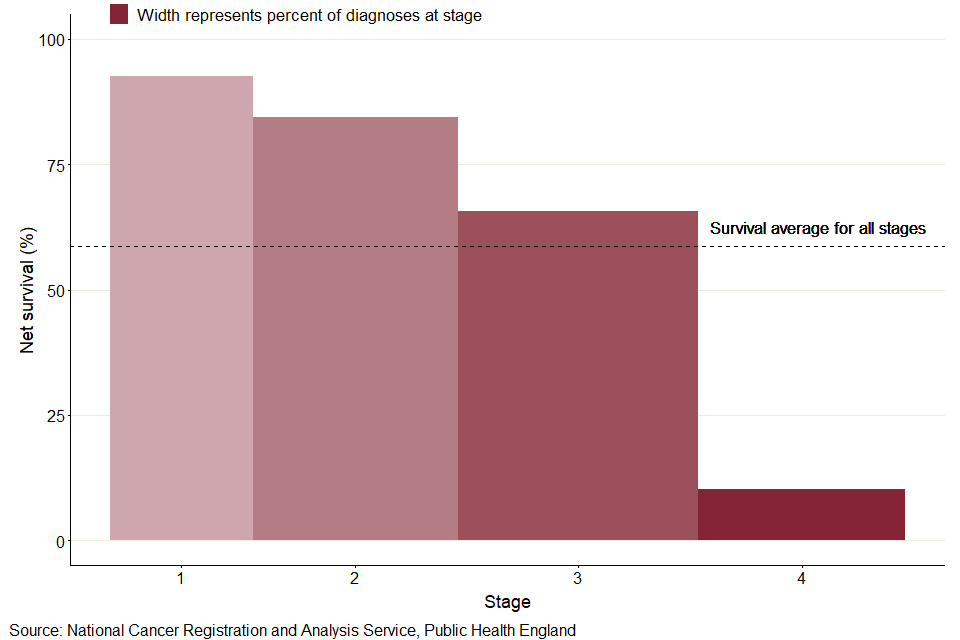
Colorectal cancer, 5-year age-standardised net survival for all stages
Chances of recovery from cancer (prognosis) depend on the stage of the disease at the time of diagnosis. The lower the stage, the better the long-term prognosis.
Early diagnosis is very important. If cancer Is detected early and treated appropriately the chances of cure are higher. While cancers which have spread to other parts of the body are difficult to treat and five-year survival in such cases is lower.
The patient's overall health
The patient's overall health such as their age, fitness, and presence of other concomitant diseases also affect the outlook for a patient with cancer. It also affects how we treat these patients. If treatment of cancer requires surgery or aggressive chemotherapy, we cannot deliver it to an already fragile patient.
Availability of treatment options
India is a vast country with wide geographic and socioeconomic variations. Depending on the cost, availability of nearby cancer centres and expertise, the availability of treatment options varies across the country. Better affordability and availability will affect the outcomes.
Important aspects of cancer care
The cure is not the only goal in the treatment of cancer. While some types of cancer can be cured, others may not be curable when detected at an advanced or metastatic stage but can be managed for a long time with ongoing treatment. For these patients treatments can help to control the cancer and extend life. Besides, advanced-stage patients also require control of symptoms and preservation of quality of life.
Cancer can have a significant impact on the lives of patients and their families. Besides physical symptoms and side effects from treatment, cancer can also cause emotional and psychological distress. Patients need to have access to supportive care services such as counselling, support groups, and palliative care.
It's important to understand that every person and every cancer is unique, and the best course of action will depend on the individual circumstances. Some patients may be eligible for clinical trials or experimental treatments that may offer a better chance of cure or control of the disease.
The most important thing you can do if you have been diagnosed with cancer is to seek the best medical care possible. This means working with a team of healthcare professionals, including a cancer surgeon, to develop a personalised treatment plan that considers your specific needs and goals.
Modern treatment of cancer, though not perfect, is effective. The five-year survival rate for all cancers combined is now over 60%. This means that over 6 out of 10 people diagnosed with cancer will be alive five years after their diagnosis.
Prevention is an important aspect of cancer control. Adopting a healthy lifestyle, such as maintaining a healthy weight, quitting smoking, limiting alcohol consumption, and getting regular exercise, can help reduce the risk of developing cancer. Cancer screening tests can detect cancer early when it is often more treatable.
Detect Early, Treat Right, Save Lives!

About Author
Dr. Nikhil Agrawal
MS, MCh
Dr. Nikhil Agrawal is a leading GI-HPB Surgical Oncologist with 20+ years of experience in complex cancers of the esophagus, stomach, colon, rectum, liver, pancreas, gallbladder, and bile ducts. He leads the GI-HPB Oncology Program at Apollo Hospitals, Delhi and Gurugram, with expertise in advanced robotic and laparoscopic cancer surgery.
His practice focuses on evidence-based, multidisciplinary care with an emphasis on individualized treatment and long-term outcomes.
He trained at BHU, SGPGI Lucknow, AIIMS New Delhi, and SNUBH, South Korea, and is a robotic surgery proctor who trains surgeons in advanced GI-HPB cancer surgery. He is also regularly invited as faculty at national and international scientific meetings.
This website helps patients and families understand GI and HPB diseases and cancers, treatment options, and what to expect during recovery and long-term care.
Related Blogs

IS ANYONE SAFE FROM CANCER?
We've been told if we don't smoke, don't drink, maintain a healthy weight, use sunscreen and eat right, we will not get cancer. Well, unfortunately, none of us is safe from cancer.

Cancer rates increasing? - Read this!
People often remark in OPD, seminars and conversations that cancer is increasing. They are seeing more people getting cancer.