Laparoscopic vs Robotic Surgery for GI and HPB Cancers: What Patients Should Know
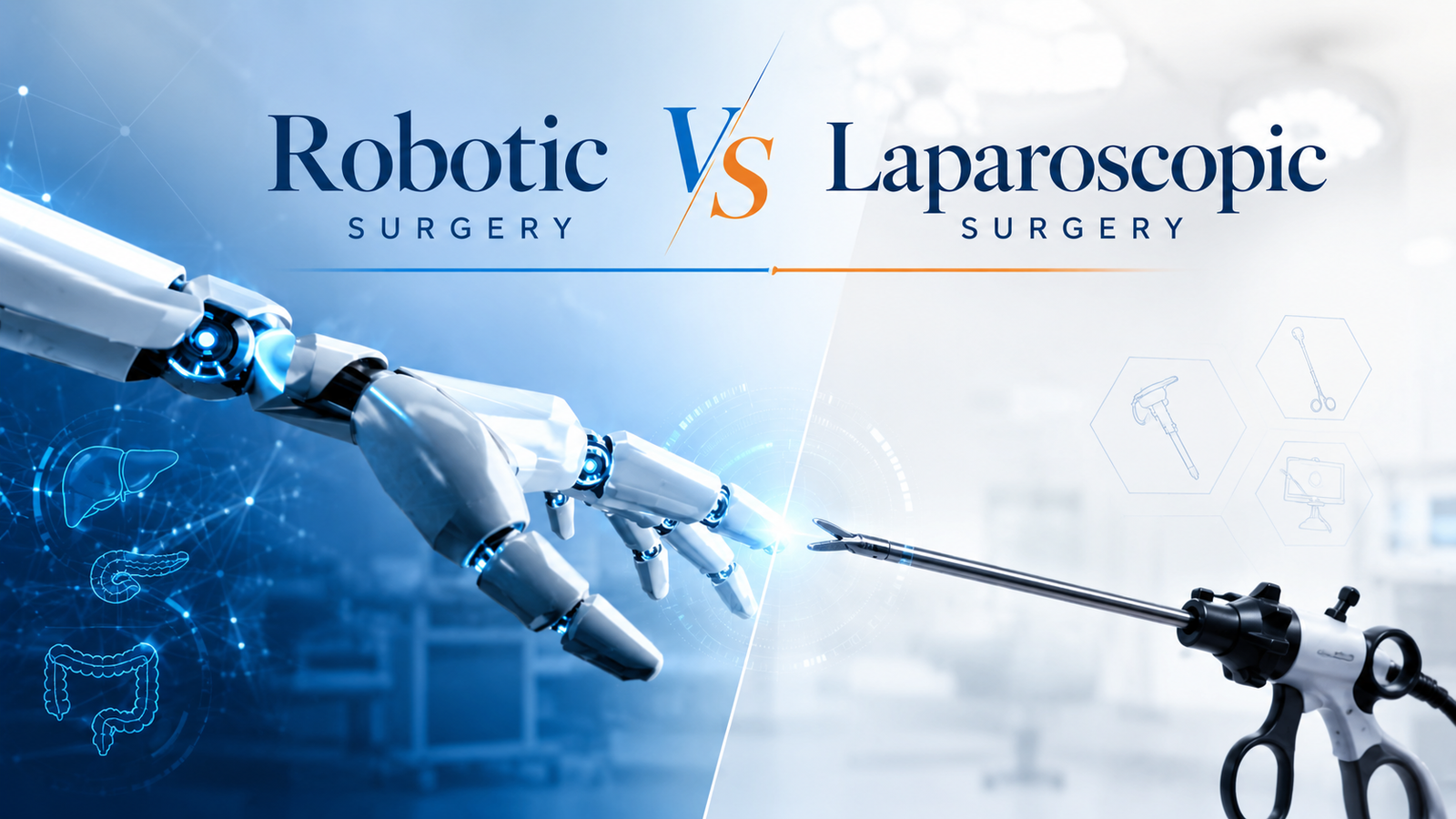


Doctor, should I choose robotic surgery because it is newer and more advanced?
Laparoscopic vs Robotic Surgery for GI and HPB Cancers: What Patients Should Know
When you or someone you love is diagnosed with cancer and needs surgery, you naturally want the safest operation, the least pain, the quickest recovery and, most importantly, the best chance of cure.
Today, many gastrointestinal (GI) and hepatopancreatobiliary (HPB) cancer operations can be performed through small keyhole incisions using either laparoscopic or robotic surgery. Both approaches are important advances over traditional open surgery. However, the most useful question is not simply which technology is better. It is: Which approach is safest and most appropriate for my cancer, my anatomy and the surgeon performing my operation?
What is laparoscopic surgery?
Instead of making one large incision, the surgeon makes several small openings in the abdomen or, for some operations, the chest. A thin, long camera is introduced through one opening, while long surgical instruments are passed through the others.
The camera provides a magnified view of the operating area on a monitor. The surgeon stands beside the operating table and directly controls the instruments.
Compared with traditional open surgery, laparoscopic surgery can offer:
- Smaller scars
- Less pain after surgery
- Earlier walking and return to normal activity
- Fewer wound-related problems
- Shorter hospital stays in appropriately selected patients
- Faster overall recovery
Laparoscopic surgery has been used successfully in GI cancer surgery for decades and is well established for many GI-HPB procedures.
What is robotic surgery?
Robotic surgery is a form of minimally invasive surgery. It uses small incisions, a camera and specialized instruments, similar to laparoscopic surgery. Because it is minimally invasive, robotic surgery offers many of the same advantages as laparoscopic surgery, such as smaller incisions, less tissue disruption, reduced postoperative pain, shorter hospital stays and faster recovery in appropriately selected patients.
The main difference is that the surgeon controls the instruments from a console through a robotic interface rather than holding them directly. The robot does not make decisions or operate independently. Every movement is controlled by the surgeon. What the robot does is provide a highly magnified three-dimensional view, make movements steadier, and surpass the rotational limits of the human hand. This gives the surgeon greater precision than straight laparoscopic instruments.
This can be particularly helpful when operating in:
- Deep or narrow spaces
- Areas surrounded by important nerves and blood vessels
- Difficult angles
- Situations requiring delicate suturing or reconstruction
Advantages of Robotic Surgery
Robotic surgery gives the surgeon better vision, greater instrument movement and more precise control than conventional Laparoscopy.
Key advantages include:
- 3D magnified vision with better depth perception
- Wristed instruments that can move and rotate more freely
- Steadier, precise movements with tremor reduction
- Better access to deep or narrow areas, such as the pelvis
- Easier delicate suturing and reconstruction
- Less physical strain on the surgeon during long operations
Laparoscopic and robotic surgery have more in common
Both Robotic and laparoscopic surgery are forms of minimally invasive surgery.
Both generally:
- Use small incisions
- Use a camera to magnify the surgical field
- Cause less injury to the abdominal or chest wall than open surgery
- Can reduce postoperative pain and wound problems
- Allow earlier mobilisation and recovery
Whether the operation is laparoscopic or robotic, the cancer must be removed completely, with appropriate margins and lymph-node clearance when required. The priority is sound cancer surgery; minimally invasive surgery comes second.
So what is actually different?
The main differences are in vision, instrument movement and surgeon ergonomics.
| Feature | Laparoscopic surgery | Robotic surgery |
|---|---|---|
| Incisions | Several small incisions | Several small incisions |
| Vision | Magnified 2D or 3D | Magnified 3D view with depth perception |
| Instruments | Long, relatively rigid instruments | Wristed instruments with greater freedom of movement |
| Precision | Precise in experienced hands | Greater instrument flexibility and control in difficult areas |
| Tremor filtration | Minimal | Steadier movements |
| Recovery | Usually faster than open surgery | Usually similar to laparoscopy |
| Surgeon ergonomics | Standing beside the patient | Surgeon sits at a console |
| Cost | Generally lower | Generally higher |
| Availability | Widely available | Limited to advanced centres |
The robotic system can make certain technical steps easier, but a technical advantage does not automatically translate into less pain, fewer complications or better cancer survival for every patient.
How does the choice vary with different cancers?
There is no single answer for all GI and HPB cancers. The choice between laparoscopic, robotic and open surgery depends on the cancer's location and extent, the patient's anatomy and health, and the experience of the treating team. Laparoscopic surgery is well established for many GI and Colon cancers, while robotic surgery may offer technical advantages in difficult dissections, reconstructions, low rectal cancers, complex lymphadenectomy and Pancreatic or Liver procedures. Esophageal, gastric, Pancreatic, Bile duct and complex Liver operations require high-volume specialist teams, because the expertise of the surgeons, anaesthetists, intensive-care specialists and postoperative-care team matters equally. Open surgery may still be the safest option for advanced or technically complex cancers. The key principle is that the operation should be chosen to achieve complete and safe cancer clearance.
Is robotic surgery always better?
Robotic surgery is a sophisticated technology, but it is not automatically safer, more effective or better for every patient. There are situations where it can provide a genuine advantage, for example, when the surgeon needs to work deep inside the pelvis, perform precise suturing or dissect around delicate structures. There are also many situations where an experienced laparoscopic surgeon can achieve an equally good result efficiently. Sometimes, for a complex Tumour or condition, open surgery might be the best option.
Common misconceptions about robotic surgery
"The robot performs the operation."
It does not. The surgeon controls every movement. The robotic system translates those movements into precise movements of the instruments inside the patient's body.
"Robotic surgery has no complications."
Every major cancer operation carries risks, including bleeding, infection, leakage from a surgical join, injury to nearby structures, blood clots and complications related to anaesthesia. Robotic technology may help with certain technical aspects of surgery, but it cannot eliminate surgical risk.
"Robotic surgery always means less pain and faster discharge."
Not necessarily. Both laparoscopic and robotic surgery use small incisions, so differences in pain and recovery between them may be relatively small. Recovery also depends on the extent of surgery, the patient's general health and nutrition, complications, pain management and the hospital's recovery programme.
"Robotic surgery cures cancer better."
There is no reason to assume that simply choosing a robot guarantees better cancer survival. The operation must still achieve the fundamental goals of cancer surgery: complete removal of the Tumour where possible, appropriate margins and adequate lymph-node assessment.
"If my surgeon converts to open surgery, something has gone wrong."
Not necessarily. Conversion can be the safest decision when the surgeon encounters unexpected bleeding, scar tissue, Tumour involvement or difficulty safely identifying important structures. A surgeon who converts early to an open operation when necessary may actually be making the right surgical decision.
What matters more than the robot?
In GI and HPB cancer surgery, these factors matter more than platform:
- The surgeon's experience with your specific operation: General robotic experience is not the same as expertise in your particular cancer surgery.
- Appropriate patient selection: Not every patient or Tumour is suitable for minimally invasive surgery.
- The entire hospital team: Complex cancer surgery depends on anaesthesia, intensive care, radiology, pathology, Endoscopy and multidisciplinary support, not just the surgeon.
- Accurate staging and planning: The operation should reflect the tumour's extent and its relationship to nearby structures.
- Sound cancer-surgery principles: Technology must never compromise complete and appropriate cancer clearance.
- Flexibility when circumstances change: The safest approach may be laparoscopic, robotic or open, depending on the patient and the operation.
What about cost?
This is especially important in India, where robotic surgery usually costs more because of the system, specialised instruments, maintenance and infrastructure. That extra expense may be worthwhile when robotics offers a meaningful advantage for a particular operation, but choosing laparoscopic surgery does not mean choosing inferior cancer treatment; for many procedures, excellent Laparoscopy remains an excellent option. Ask your surgeon what specific benefit robotics is expected to provide in your case and whether it justifies the additional cost.
Questions patients should ask their surgeon
Before making a decision, consider asking:
- Is minimally invasive surgery appropriate for my cancer and stage?
- Why do you recommend laparoscopic, robotic or open surgery in my case?
- How many of these specific cancer operations have you performed using this approach?
- What are the main risks in my particular case?
- What is the possibility that the operation may need to be converted to open surgery?
- Are the expected cancer clearance and long-term outcomes comparable?
- How long might I stay in hospital?
- When can I reasonably expect to return to normal activities?
- Does the robotic approach provide a meaningful benefit for me, or mainly additional cost?
- What treatment might I need before or after surgery?
- Will my case be discussed by a multidisciplinary cancer team?
A good surgical consultation should explain not only what is technically possible, but also what is medically sensible for you.
The bottom line
Laparoscopic and robotic surgery are both valuable minimally invasive tools in modern GI and HPB cancer surgery. Robotic technology offers genuine technical advantages, including three-dimensional vision, greater instrument flexibility and improved control in difficult or confined spaces. However, these advantages do not make it universally superior. For many patients, experienced laparoscopic surgery can provide excellent cancer treatment, recovery and value; for selected technically difficult operations, robotic surgery may offer meaningful benefits; and for some patients, open surgery remains the safest and most appropriate choice.
The key is not to choose the machine, but the right operation performed by an experienced team, in the right patient, for the right reason. Both laparoscopic and robotic surgery use small incisions and may offer recovery advantages over open surgery. The robot is surgeon controlled and does not operate independently. Its benefits may be particularly useful in deep pelvic surgery, difficult dissection and complex reconstruction, but it is not automatically better for every operation. Surgeon experience, appropriate patient selection, accurate staging, multidisciplinary care and complete cancer removal matter more than the platform alone.